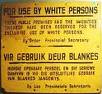
 South African politics have changed tremendously over the last few decades. Apartheid began in South Africa in 1948 but that collapsed in 1994. Apartheid (which is an Afrikaans word meaning separateness) basically meant that blacks and colored faced severe racial discrimination as well as total segregation by law. This was set up by the country’s National Party government and meant that the whites had minority rule. But 1994 signaled the start of a new era with South Africa’s first democratic election. While this has had its advantages, day-to-day life can be extremely volatile for the whites since without the segregation of so many decades, there is constantly the threat of violence from the non-whites. On the plus side, the economy has emerged as being “one of the most flourishing in the world.” As well, since 1994, the National Congress Government has created various policies as a way of developing its economy. The republic’s annual growth rate is around 3.3% but it still suffers in its health sector, being home to the largest amount of HIV patients in the world. As well, despite its economic prominence, half of its population lives under the poverty line. People blame this on the republic’s political situation.
Understanding European Politics
Many people have a hard time figuring out the make-up of European politics. So here are some basics to get you started: The executive body of the European Union (EU) (known as the European Commission) comprises 27 commissioners and is located in Brussels. Its tasks include: legislation proposal; ensuring treaty compliance. The European Parliament (the European Union’s directly elected parliamentary institution) comprises 736 members and meets in Strasbourg and Brussels. It is the EU’s legislative branch. Then there is the European Council (EU institution “responsible for defining the general political direction and priorities of the Union”) comprising heads of each nation state’s government/states, meeting quarterly. Of course, there is much more that goes on in European politics, but at least this makes a start to get you acquainted somewhat with European politics.
What Are the British Lib Dems to Do?
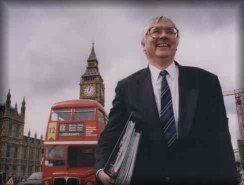 Following the resulting Hung Parliament from Great Britain’s recent election, members of the Liberal Democrat Party are attempting to find ways to preserve their voice in Parliament. The concern among those in the Party is that by joining with the Conservative Party, they will lose their voice “at a national level.” What is expected to happen amongst the leadership is that pressure will mount from those seeking Liberal Democrat spokespeople being appointed for “all portfolio areas where the party does not have a minister in government.” In these areas, it is “absolutely crucial the Lib Dem distinctive voice….is made clear and that we are afforded that right on the basis we don’t have a minister,” insisted Colchester MP Bob Russell. Only time will tell how this pans out for the Liberal Democrats and what voice will ultimately win on the House of Commons ground.
Great Britain, the World Cup and Crime Prevention Minister
 The British are notorious for their unruly behavior at football matches. So much so, that it has now gotten to the point where the government minister for crime prevention, James Brokenshire has “begged England fans to behave well during the forthcoming World Cup.” Apparently, Minister Brokenshire has gone a step further than his plea and has taken “drastic steps to stop the worst football hooligans to South Africa.”
This doesn’t do well for the image of Brits of quiet, conservative, upstanding civic individuals. It’s a true case also of politics getting into every area of life. If politics now has to involve itself in sport – as this move clearly indicates – then it shows the Brits can’t be trusted on certain levels and could lead to more governmental intervention in the future.
In other words, if the British people does not clean up its act on the football pitch and government ministers have to get involved to this level, the question becomes, what is this going to mean for the future of the British people and governmental intervention? The Brits would be well advised to watch out and clean up their act.
The Judicial Branch of the American Government
The Supreme Court is the highest court that America has in its federal court system. Below them are courts of appeal and below this are district courts.
Individual court systems of each state also exist, and are separate from the federal court system, but they aren’t entirely divorced from the system or independent from it. Each of these individual court systems in each state has its own laws and its own procedures. Each state also has a Supreme Court for the state and they are the final authority on the interpretation of the state’s laws.
A case can move from a state court to the U.S. Surpreme Court when there is a federal question involved.
If you look at the break down of the court system in America, it consists of the following: the Supreme court, 13 courts of appeal, 94 district courts and two courts of special jurisdiction.
The UK is Sort of Stuck Now
 Since it seems like the British people simply couldn’t make up their collective minds, the aftermath of the UK’s recent election results has the country n a bit of a mess. What happened with the national elections was that no single party won a clear overall majority. This means that forming a government is not going to be as straightforward as it usually is. This situation has not occurred in Britain for nearly 40 years.
Understanding a Hung Parliament
When no single party has enough Members of Parliament (MPs) elected to form a majority in the House of Commons, a hung parliament ensues. That means that whatever party ultimately ends up as the government, it will not have the power needed to pass laws without getting the backing from the other parties. In other words, no one single party will have ultimate control. This produces two options: either there will be a formal coalition among the smaller parties, or the larger party will just have to hope that once in power, the smaller parties will support it to get its laws passed. So it’s certainly going to be interesting as to what will now transpire in Britain’s parliamentary system.
History about George Washington
As everyone knows, the first president of the United States of America was George Washington. On April 30, 1789, George Washington took his official oath of office while standing on a balcony of Federal Hall on Wall Street in New York.
He wrote to James Madison, understanding how important his swearing in was, that “As the first of everything, in our situation will serve to establish a Precedent. It is devoutly wished on my part, that these precedents may be fixed on true principles.”
After the Revolutionary War, Washington actually longed to retire to his fields at Mount Vernon. He realized, however, that a new Constitution was necessary in America and he worked tirelessly to see that it was ratified. After its ratification at the Constitutional Convention in Philadelphia in 1787, he was elected as president by a unanimous vote from the Electoral College.
The two party system developed by the end of his first term. By the end of his second term, weary of politics and feeling old, he retired. During his Farewell Address, he warned the people not to focus too much on geographical distinctions or on party lines. He also warned about long-term alliances in foreign affairs.
How the United States Cabinet Works
Most of us know that the President of the United States has a cabinet, but exactly who is in this cabinet? And what do these people do? The United States Cabinet is comprised of the most senior appointed officers of the executive branch of the federal government. Each cabinet officer is nominated by the President and then confirmed by the Senate. After the President nominates a potential Cabinet member, the Senate takes a vote and decides, by a majority vote, whether to confirm or reject this nomination.
All Cabinet heads are referred to as “Secretary” except for the Attorney General. Today’s cabinet includes the Vice President and the heads of 15 executive departments. In addition, there are five other people who have cabinet ranks.
Interestingly, the Cabinet has been in existence since George Washington. Washington had a cabinet of four people including the Secretary of State, the Secretary of the Treasury, the Secretary of War and the Attorney General. Even today, these four titles are the four most important members of the President’s Cabinet.
The Cabinet is a very important part of the presidential line of succession. This line of succession, in order includes: Vice President, Speaker of the House of Representatives, President Pro Tempore of the Senate, Secretary of State, Secretary of the Treasury, Secretary of Defense, Attorney General, Secretary of the Interior, and so on. The government tries to make sure not to have all of these people in the same place so that the succession can run smoothly, should something terrible happen.
Politics: Are You A Small Or Big P?
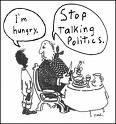 Even if you are the kind of person who sees yourself as totally apolitical, on some level, you are involved in politics, whether you like it or not. Of course, we’re talking here of politics with a small p. That can cover anything from where you buy your fruit to how you feel about God or the lack thereof of an omnipresent being. You don’t have to be an expert on Obama – or even have an opinion on the guy – to be political. At least, that is the case with small p politics.
Politics with a big P is an entirely different story. If you claim to be that kind of expert, then you probably are extremely familiar and would be confident to discuss America’s electoral system (versus that of the one used in the UK which is entirely different); when your local elections are taking place; and the laws of abortion and speeding in each of America’s 50 states. You might even be thinking of running for a political position yourself at some point. In that case, you for sure would be the kind of person who is involved in Politics with a big P.
Either way, it is a matter of preference and priorities. Some people are just not bothered about how their state is run, or just do not have the energy or will to get involved. Still, even those people are not apolitical. Everyone has an opinion on something that is somehow connected to politics, even if it is politics with a small p.
What Are Electoral Votes?
If you took a poll of voting Americans, most would probably say that they actually voted for the President. What they don’t realize is that they actually voted for electors – individuals who vote for the electoral college. They didn’t actually vote directly for the President.
How does this process work? The total electoral vote, and not the popular vote, actually decides the elections. There is a total of 538 electoral votes in the country. Excluding the chance of having a third-party candidate, one of the two main candidates needs to get at least 270 total electoral votes to be elected as the President.
When you vote in your states, you’re actually voting towards your electoral votes. Alabama, for instance, has 9 electoral votes while California has 54. Each state’s electoral votes are determined by the relative size of the state’s population. If the majority of the citizens who vote in Alabama vote for the democratic candidate, then he gets all 9 of those electoral votes.